


RM700 Million Investment Pipeline to Develop More Than 20 Bio-CNG Facilities in Malaysia Using Palm Oil Industry Waste
PUTRAJAYA, 19 June 2026 – Malaysia and the Republic of Korea have further strengthened their strategic partnership in renewable energy through the exchange of a Letter of Intent (LOI) for the Terengganu State Palm Oil Mill Biogas Upgrading Project, an initiative that will convert palm oil industry waste into Bio-Compressed Natural Gas (Bio-CNG).
Supported and coordinated by the Malaysian Bioeconomy Development Corporation (Bioeconomy Corporation), the project brings together South Korean renewable energy companies Polaris Bio Co., Ltd. (Polaris Bio) and Sudokwon Landfill Site Management Corporation (SLC), together with Malaysian technology partner MTC Orec Sdn. Bhd. (MTC Orec), to unlock the commercial potential of palm oil industry waste as a high-value clean energy source.
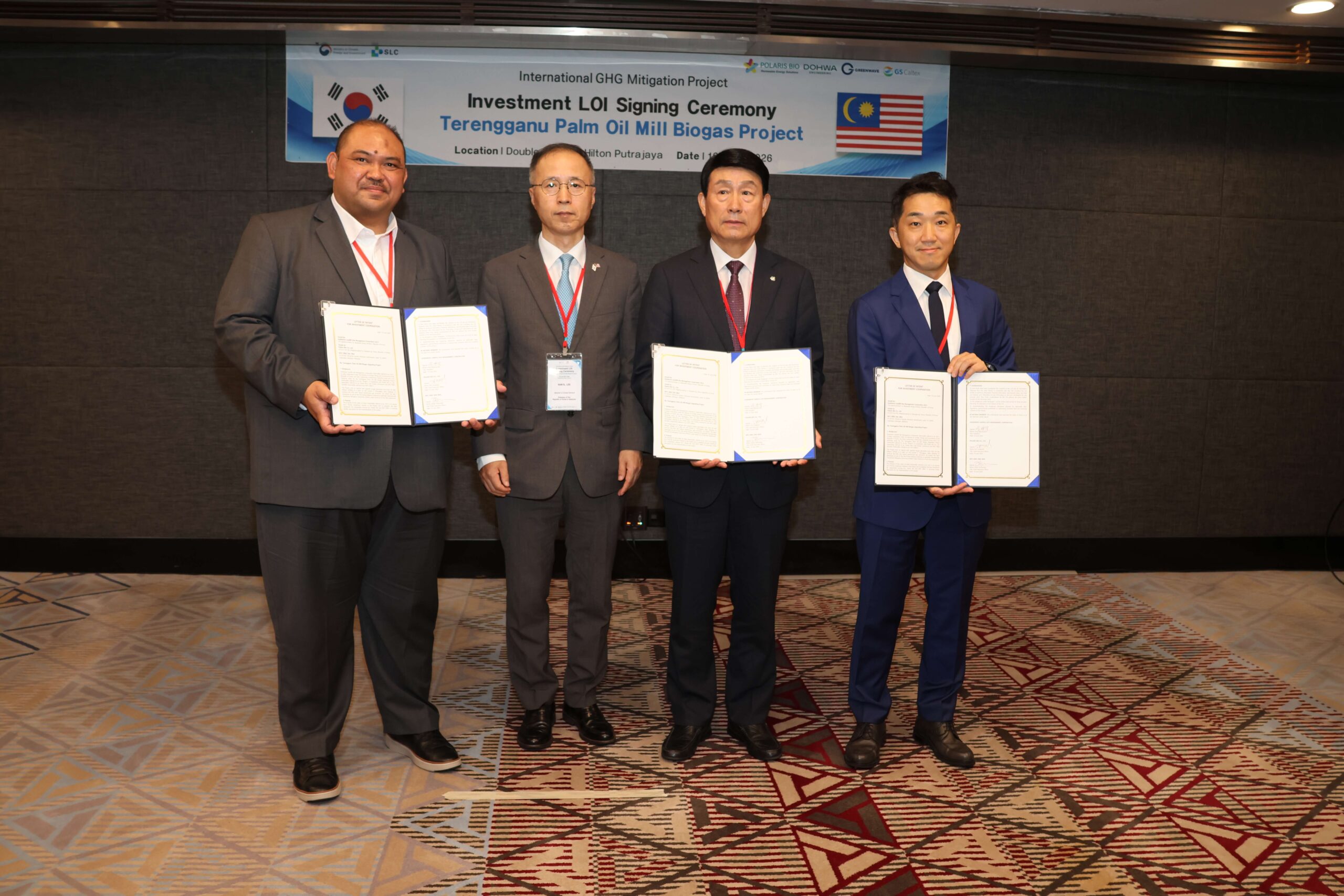
The Letter of Intent for the project was signed by Mr. Song Byeong-eok, President of SLC, Mr. Junghwan Kim, Chief Executive Officer of Polaris Bio, and Dr. Zahari Mohamad, Chief Executive Officer of MTC Orec. The ceremony was witnessed by Mr. Han-il Lee, Minister and Consul General of the Embassy of the Republic of Korea.
The LOI signing ceremony was attended by approximately 40 representatives from government agencies, public institutions and private-sector organisations from both countries, including Mr. Ahmad Farid bin Mohammed, Climate Change Division Undersecretary of the Ministry of Natural Resources and Environmental Sustainability.
The Terengganu Bio-CNG Project is a continuation of the Memorandum of Understanding (MoU) signed between Bioeconomy Corporation and Polaris Bio in October 2025 for the feasibility study and development of biogas projects. The initiative paved the way for a RM700 million investment pipeline to develop palm oil waste-based Bio-CNG facilities across Malaysia.
In the long term, the initiative aims to establish more than 20 biogas upgrading facilities based on Palm Oil Mill Effluent (POME) across Malaysia. The Terengganu project is expected to be among the earliest developments under this initiative and will serve as a reference model for future projects nationwide.
Through this facility, biogas generated from POME, a liquid by-product of palm oil milling operations will be processed and upgraded into Bio-CNG, a cleaner renewable fuel suitable for use in transportation, industrial applications and electricity generation.
By harnessing biotechnology to convert palm oil waste into a high-value energy resource, the project supports Malaysia’s transition towards cleaner energy while enhancing national energy security through reduced reliance on fossil fuels.
Nationwide implementation of the initiative is expected to reduce greenhouse gas emissions by up to 384,000 tonnes of carbon dioxide equivalent (CO₂e) annually, contributing to Malaysia’s energy transition agenda and sustainable development goals.
Chief Executive Officer of Bioeconomy Corporation, Mr. Mohd Khairul Fidzal Abdul Razak, said the Terengganu Bio-CNG Project marks an important milestone in the development of Malaysia’s palm oil waste-based Bio-CNG industry while reinforcing the country’s position as a preferred destination for bioeconomy and renewable energy investments in the region.
“Building on the RM700 million investment pipeline announced last year, this initiative demonstrates that Malaysia’s POME-to-Bio-CNG ambitions are moving beyond the feasibility stage into actual implementation”.
“This development comes at a time when global biogas and biomethane production is projected to increase by 22 per cent between 2025 and 2030. We look forward to seeing this strategic partnership continue to grow and contribute to the advancement of Malaysia’s bioeconomy and renewable energy sectors,” he said.
He added that Malaysia’s palm oil industry generates substantial volumes of biomass and by-products that can be converted into high-value renewable energy resources. Innovations such as Bio-CNG can transform palm oil waste into new economic opportunities while strengthening energy security and supporting the country’s low-carbon development agenda.
Throughout the project development process, Bioeconomy Corporation has played a strategic role in connecting Malaysian and Korean stakeholders through investment facilitation, government engagement and market access support. Its involvement has further strengthened investor confidence in Malaysia’s growing bioeconomy and renewable energy sectors.
Project implementation will involve Polaris Bio and MTC Orec, a company under Bioeconomy Corporation’s Bio-based Accelerator (BBA) programme. MTC Orec will provide local technical expertise, while SLC has supported project development through feasibility studies, technical assessments, carbon reduction calculations and investment facilitation.
SLC and its consortium partners: GS Caltex Corporation, Dohwa Engineering Co., Ltd. and Greenwave Co., Ltd., have undertaken extensive field surveys, technical reviews and commercial feasibility studies over the past year to evaluate the project’s viability.
The project will initially involve one palm oil mill in Terengganu, with plans for future expansion. Preliminary development activities are expected to commence in 2027, while commercial operations are targeted to begin in 2029.
Beyond renewable energy generation, the project is expected to support bilateral technology transfer between Malaysia and Korea, create employment opportunities, strengthen local expertise and contribute to the development of a more resilient bioeconomy ecosystem.
The initiative is also aligned with Malaysia’s National Energy Transition Roadmap (NETR), which targets 40 per cent renewable energy capacity in the national energy mix by 2035, as well as the National Biotechnology Policy 2.0 (DBN 2.0), which promotes innovation-driven and sustainable bio-based industries.
The project also marks another significant milestone in international climate cooperation. During the ceremony, NRES, Malaysia’s lead ministry for greenhouse gas reduction projects, issued a Letter of Acknowledgement for the development.
The acknowledgement makes this the first Malaysia-Korea project to receive formal recognition from the Malaysian Government under Article 6.2 of the Paris Agreement, establishing a foundation for future international carbon reduction cooperation between Malaysia and the Republic of Korea.
President of SLC, Mr. Song Byeong-eok, said the organisation remains committed to supporting international climate initiatives that deliver both environmental and economic benefits.
“SLC has developed extensive expertise in greenhouse gas reduction initiatives and has achieved more than 8.82 million tonnes of greenhouse gas reductions since 2006. We look forward to the successful implementation of this project while further strengthening renewable energy cooperation between Korea and Malaysia,” he said.
-END-